


Wheel alignment doesn’t touch the tires at all — it adjusts angles in the steering and suspension so the tires meet the road correctly. If your car pulls to one side, wears tires unevenly, or the steering wheel sits crooked when you’re driving straight, alignment is usually the fix, but not always. Get this wrong and you’ll pay for an alignment that doesn’t solve the actual problem.
What Alignment Actually Changes
Three angles matter: toe, camber, and caster.
Toe is whether the front edges of the tires point slightly inward or outward when viewed from above. Even a small amount of toe error — a fraction of a degree — makes tires drag sideways as they roll, which is why toe misalignment causes the fastest, most visible tire wear of the three. You’ll see it as a feathered edge you can feel by running your hand across the tread: smooth one direction, rough the other.
Camber is the inward or outward lean of the wheel viewed from the front. Negative camber (top of the wheel tilted in) wears the inside edge of the tire faster; positive camber wears the outside edge. Camber isn’t something you can eyeball reliably — a couple degrees off doesn’t look dramatic, but it’s enough to chew through a tire’s inner edge in under 10,000 miles.
Caster is the forward or backward tilt of the steering axis, viewed from the side. This one doesn’t show up as tire wear the way toe and camber do — it shows up as handling behavior. Too little positive caster and the steering feels light and wanders; the wheel doesn’t return to center on its own after a turn. Caster is also the angle most shops can’t adjust on many modern cars without replacing control arms or strut mounts, because it’s built into the geometry rather than set with a bolt.
Can You Actually Do This at Home?
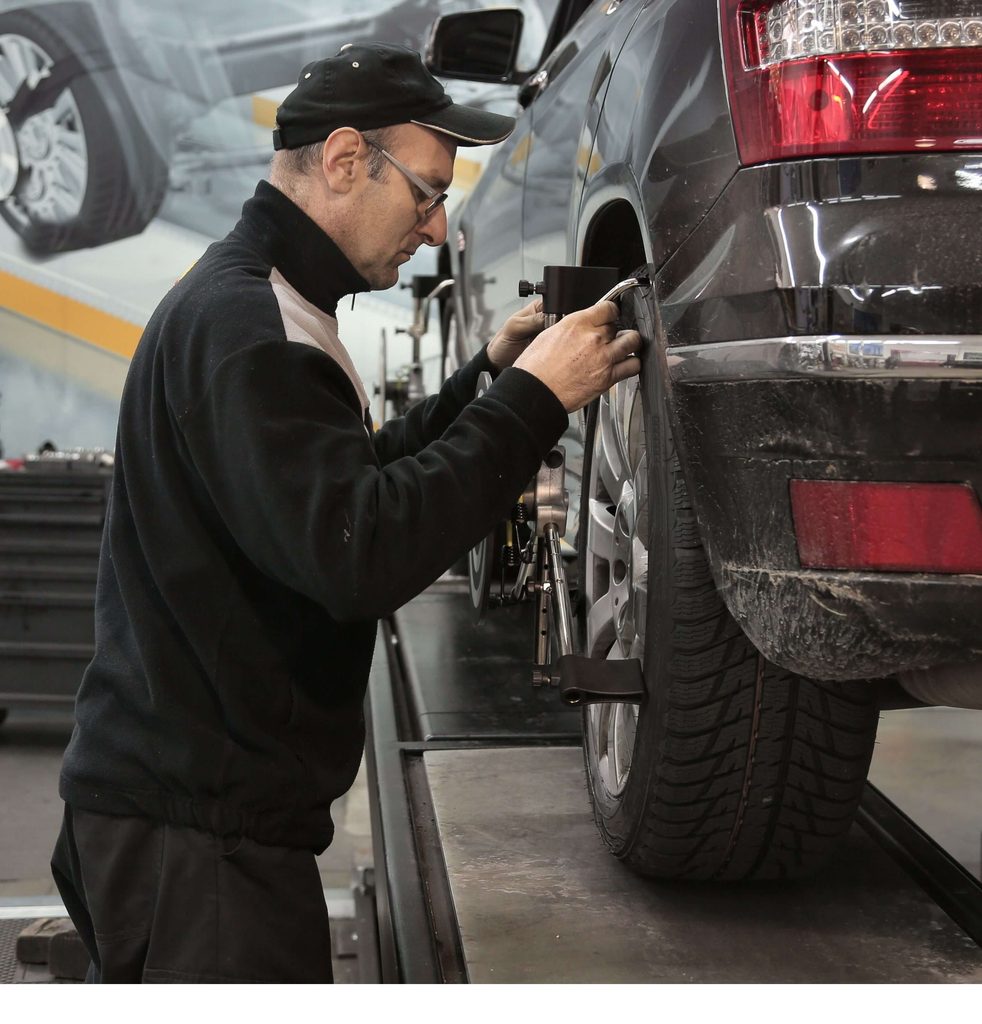
Partially, and it’s worth being honest about where the line is.
Toe you can check yourself with a tape measure and two jack stands, or more accurately with a length of string run parallel to the car’s centerline at hub height, measured off the front and back of each rim. If the front measurement is smaller than the rear, the wheels toe in; if it’s bigger, they toe out. On most cars, toe is adjusted at the tie rod — loosen the locknut, twist the tie rod to lengthen or shorten it, retighten. This is genuinely a driveway job on many vehicles, and it’s the one alignment parameter most likely to drift after you hit a pothole or curb hard.
Camber and caster are a different story. You can measure camber with a magnetic angle gauge held against the wheel face, but adjusting it usually means loosening strut-to-knuckle bolts (on cars with slotted mounting holes) or adding shims — and on a lot of newer vehicles, particularly ones with MacPherson strut front ends and fixed rear geometry, there’s no camber adjustment at all unless you install aftermarket camber bolts or adjustable control arms. Caster typically isn’t adjustable without aftermarket parts either.
The honest answer: toe is a legitimate DIY task with basic tools. Camber and caster are measurable at home but rarely fixable without either the right adjustment hardware or a shop lift and alignment rack. If a shop tells you your car “has no adjustment” for camber, that’s often literally true by factory design, not an upsell.
Signs You Need an Alignment (and Signs You Might Not)
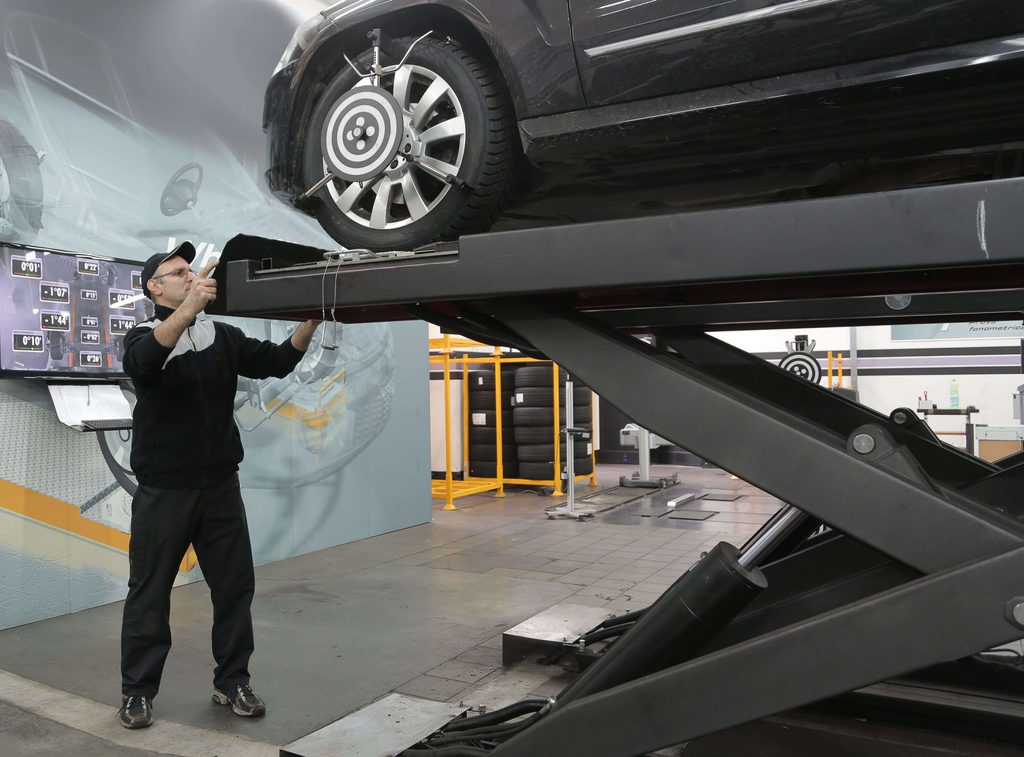
Pulling to one side is the most common complaint, but it’s not proof of misalignment by itself. Check tire pressure first — a tire even 5 PSI lower than its opposite number will pull the car toward that side, and it costs nothing to rule out. Road crown (most roads slope slightly toward the shoulder for drainage) also causes a mild, consistent pull that has nothing to do with your car.
A crooked steering wheel while driving straight is a stronger signal, especially if it appeared suddenly after hitting a curb or pothole hard. That’s a classic toe-out symptom.
Uneven wear across the tread width — inside edge, outside edge, or a feathered pattern you can feel with your hand but not always see — is the most reliable alignment indicator, because pressure and road crown don’t cause that specific pattern. Cupping (scalloped dips around the tread) points somewhere else entirely — usually a worn shock or strut, not alignment.
The car “wanders” and doesn’t track straight without constant correction often points to caster rather than toe, particularly if the steering wheel doesn’t self-center after a turn the way it should.
Where the Standard Advice Breaks Down
Alignment specs assume the suspension underneath them is in good condition. If a tie rod end, ball joint, or control arm bushing is worn out, an alignment shop can dial the angles in perfectly on the rack and have them drift out of spec within days, because the worn part keeps moving under load. A shop that’s doing this right will check for play in the steering and suspension before touching the adjustment bolts — if yours doesn’t, ask.
Lowered or modified suspensions often fall outside the factory adjustment range entirely. If you’ve dropped the car more than an inch or two, stock camber and caster adjusters frequently can’t bring the angles back into spec, which is why lowered cars commonly run aftermarket camber plates or adjustable control arms even when the factory car never needed them.
New tires don’t need an alignment by default — tire wear and alignment are related but separate. If your old tires wore evenly, a new set doesn’t require realignment just because they’re new. But if the old tires wore unevenly, put new tires on without correcting the underlying alignment and you’ll wear the new set the same way.
DIY Toe Adjustment vs. Shop Alignment
| Method | Best For | Main Advantage | Main Limitation |
|---|---|---|---|
| String/tape measure toe check | Rough toe diagnosis, catching an obvious problem | Free, takes 20 minutes | Not precise enough to hit tight factory tolerances |
| Home toe adjustment | Minor toe correction with basic tools | No labor cost | Doesn’t touch camber or caster at all |
| Shop alignment (4-wheel) | Any real symptom — pulling, wander, wear | Measures and corrects all angles, catches worn parts | Costs money; still can’t fix angles with no adjustment range |
FAQs
Does a shop alignment fix camber if my car “has no adjustment”?
Not by default. Some vehicles genuinely ship with fixed camber and no factory adjustment mechanism. A shop can sometimes correct it with aftermarket camber bolts or shims, but that’s an added part, not a standard alignment service — ask specifically whether they’re quoting a stock alignment or one that includes aftermarket adjusters.
How often should I get an alignment if nothing seems wrong?
There’s no fixed mileage interval that applies universally — it depends on road conditions and driving habits more than time. Checking after hitting a significant pothole or curb, or every time you replace tires, catches most real problems without paying for unnecessary checks.
Can bad alignment cause a vibration?
Not directly. Vibration at speed is almost always a wheel balance or tire uniformity issue, not alignment. Alignment problems show up as pulling, wander, or uneven wear — not vibration. Don’t pay for an alignment to fix a shake; get the wheels balanced first.
I just did a toe adjustment myself — do I still need a shop alignment?
If toe was the only issue and your measurements were careful, you may have solved it. But a home string measurement isn’t as precise as an alignment rack, and it tells you nothing about camber or caster. If the pull or wear pattern persists after your adjustment, that’s a sign something beyond toe is off.
