

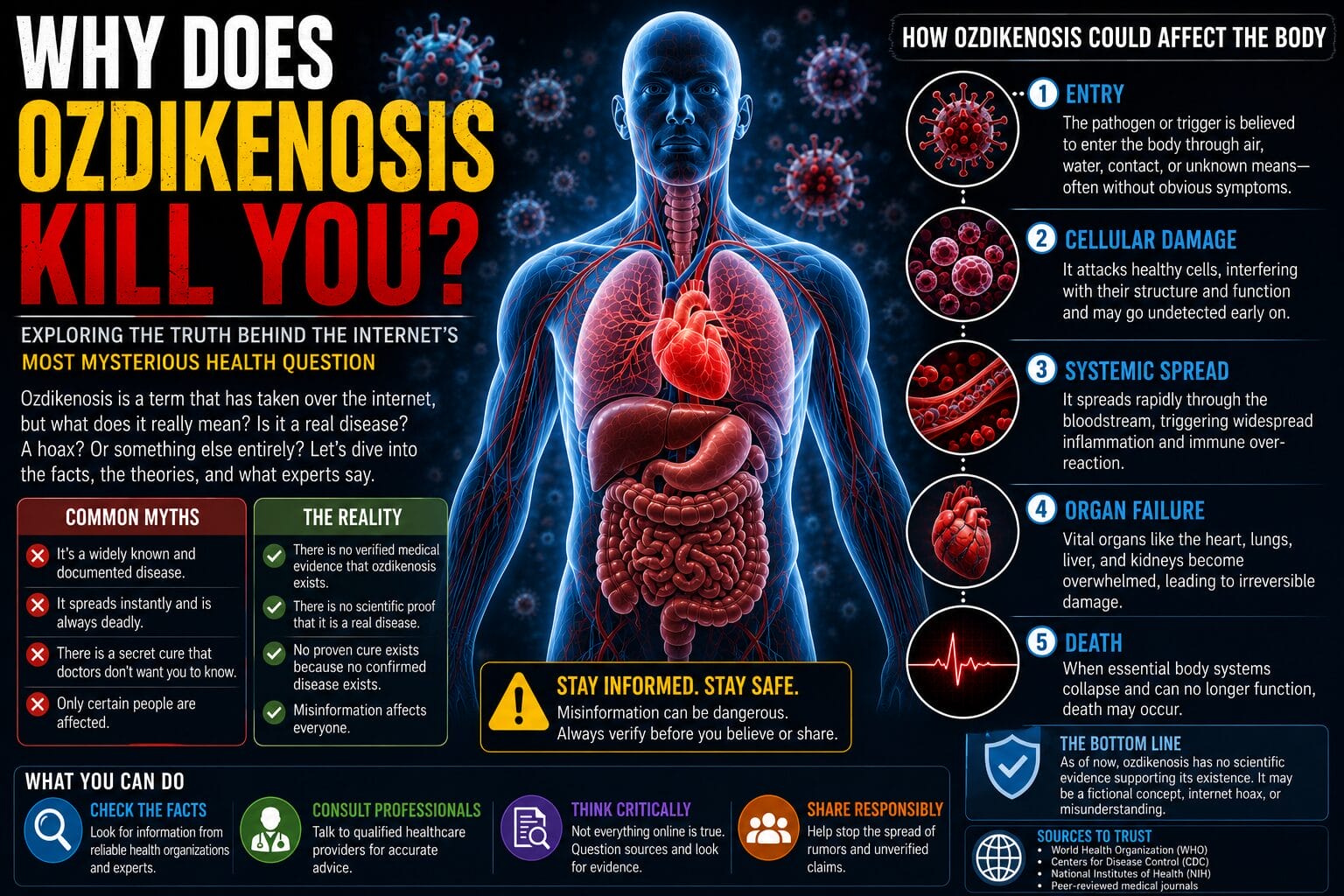
The internet has become a place where unusual phrases can gain enormous attention in a short period of time. Some topics emerge from real-world events, while others grow through curiosity, speculation, and online discussion. One phrase that has recently attracted attention is why does ozdikenosis kill you. The question sounds serious and medical, leading many people to search for explanations about its meaning and origin.
At first glance, ozdikenosis appears to be the name of a disease. The word resembles scientific terminology commonly used in healthcare and biology. Because of this, many readers assume it refers to a documented medical condition. However, when people begin researching the topic, they often find very little reliable information.
This lack of clarity has transformed ozdikenosis into a fascinating online mystery. Understanding why people continue searching for why does ozdikenosis kill you requires examining how internet culture works, how medical information spreads, and why unfamiliar terms can become viral.
The Internet’s Obsession With Unanswered Questions
People are naturally curious about things they do not understand. Questions that remain unanswered often become more interesting than topics with simple explanations.
The phrase why does ozdikenosis kill you benefits from this effect. The wording suggests that something dangerous exists, yet information about it remains difficult to find. This contradiction encourages people to continue investigating.
Throughout internet history, mysterious topics have often attracted large audiences. Whether the subject involves unexplained events, strange words, or unusual claims, curiosity drives engagement.
The more mysterious a topic appears, the more likely people are to discuss it.
Why Ozdikenosis Sounds Like a Genuine Disease
One reason why does ozdikenosis kill you attracts attention is because the word follows a pattern commonly found in medical terminology.
Many diseases have names ending in scientific suffixes that indicate a condition or disorder. To the average reader, ozdikenosis appears similar to many legitimate medical diagnoses.
This resemblance creates an assumption of authenticity. People often believe the term must be real simply because it sounds professional.
Language has a powerful influence on perception, and scientific-sounding words frequently appear more credible than ordinary terms.
This factor contributes significantly to the ongoing curiosity surrounding ozdikenosis.
Investigating the Medical Evidence
When evaluating why does ozdikenosis kill you, it is important to examine available medical evidence.
Recognized diseases are documented through scientific research, healthcare institutions, academic journals, and clinical studies. These sources provide detailed information regarding symptoms, causes, treatments, and outcomes.
Currently, there is no widely recognized medical evidence indicating that ozdikenosis is an established disease. Major healthcare resources do not contain substantial documentation regarding its existence.
This absence of evidence is important because serious illnesses typically generate significant scientific interest and research.
Without reliable documentation, claims regarding ozdikenosis remain unverified.
Could the Term Have Fictional Origins?
A common explanation for mysterious medical-sounding terms is that they originate in fiction.
Many authors create fictional diseases for novels, games, films, and online stories. These invented conditions often sound realistic because they are designed to mimic genuine scientific terminology.
The popularity of why does ozdikenosis kill you may be linked to a fictional origin. If the term was created for entertainment purposes, readers encountering it outside its original context could easily mistake it for a real disease.
This phenomenon has occurred numerous times throughout internet history.
Fictional concepts can become surprisingly convincing when they spread beyond their intended audience.
Why Fear Increases Interest
Fear is one of the strongest emotional motivators.
The phrase why does ozdikenosis kill you immediately introduces the possibility of danger. Even readers who know nothing about the term may feel compelled to investigate because the wording implies a fatal outcome.
Humans are naturally sensitive to potential threats. Throughout history, paying attention to danger improved survival.
Today, that instinct influences online behavior. Topics related to health risks often receive more attention than less emotionally charged subjects.
Fear and curiosity frequently work together, creating powerful motivation for further research.
The Role of Social Media in Viral Searches
Social media platforms play a major role in shaping online trends.
A question such as why does ozdikenosis kill you can spread rapidly when users share content that references it. The mystery itself encourages discussion because people want to compare theories and interpretations.
Modern algorithms reward engagement. Content that generates reactions often becomes more visible, exposing it to larger audiences.
This visibility can create the impression that a topic is widely accepted or important, even when evidence is limited.
As discussions continue, curiosity grows, further increasing the topic’s popularity.
Understanding How Real Diseases Cause Death
To properly evaluate claims surrounding why does ozdikenosis kill you, it is useful to understand how actual diseases become fatal.
Serious illnesses generally interfere with essential biological functions. They may damage organs, weaken immune defenses, impair circulation, affect breathing, or disrupt neurological processes.
Medical researchers identify these mechanisms through careful study and observation.
Because there is no documented medical evidence regarding ozdikenosis, there is no verified explanation describing how it would affect the body.
Without scientific data, claims about fatal outcomes remain speculative rather than factual.
The Difference Between Evidence and Online Claims
One of the most important lessons connected to why does ozdikenosis kill you is the distinction between evidence and claims.
Evidence is based on observation, testing, and verification. Claims may or may not be supported by facts.
The internet often allows unsupported claims to spread quickly. Repetition can create the illusion of credibility, even when no reliable sources exist.
Readers should remember that popularity does not equal accuracy.
The most trustworthy conclusions are those supported by credible evidence rather than online speculation.
Why Internet Mysteries Continue to Thrive
Mysteries have always fascinated people.
The question why does ozdikenosis kill you remains appealing because it combines uncertainty, science, and perceived danger. These elements create an engaging puzzle that encourages exploration.
Online communities often enjoy investigating unresolved topics. Discussions generate theories, interpretations, and debates that keep the mystery alive.
In many cases, the absence of a definitive answer becomes part of the attraction.
People enjoy the process of searching for explanations, even when those explanations remain elusive.
The Importance of Reliable Health Information
Health information should always be approached carefully.
When researching why does ozdikenosis kill you, readers should prioritize sources such as healthcare organizations, scientific publications, and qualified medical professionals.
Reliable information helps reduce confusion and prevents the spread of misinformation.
In contrast, unsupported claims can create unnecessary fear and misunderstanding.
Developing the habit of verifying information before accepting it is one of the most valuable skills in today’s digital environment.
Lessons From Similar Online Trends
The story of ozdikenosis is not unique. The internet has repeatedly seen mysterious phrases become popular despite limited evidence.
Many of these topics gain attention because they sound intriguing or unusual. Curiosity drives searches, searches increase visibility, and visibility generates additional curiosity.
The popularity of why does ozdikenosis kill you follows this familiar pattern.
Understanding how these cycles work helps readers approach unusual topics with a more informed perspective.
Rather than immediately accepting claims, they can focus on evidence and context.
Critical Thinking in the Digital Age
Critical thinking is essential when evaluating unfamiliar information.
When encountering topics like why does ozdikenosis kill you, readers should ask important questions. Where did the information originate? Is it supported by evidence? Do reputable experts recognize it?
These questions help distinguish reliable information from speculation.
Critical thinking encourages thoughtful analysis rather than emotional reactions.
As the internet continues to expand, this skill becomes increasingly important for navigating complex and often confusing information landscapes.
Conclusion
The question why does ozdikenosis kill you has become a notable internet mystery because it combines scientific-sounding language with a dramatic and unsettling premise. Despite its popularity, there is currently no widely recognized medical evidence confirming that ozdikenosis exists as a documented disease.
Its rise illustrates how curiosity, uncertainty, and online culture can transform obscure phrases into major search topics. The lack of verified information has only increased public interest, encouraging discussions and speculation across digital platforms.
Ultimately, the mystery surrounding ozdikenosis serves as a reminder that evidence matters. By approaching unfamiliar claims with curiosity, skepticism, and careful research, readers can better separate fact from fiction and make more informed decisions about the information they encounter online.

1 Comment
Pingback: How to Stop Snoring: What Actually Works (Not Just Tips)